
Electric Mobility Device (E-Device) Policy
Version: 1.0
Policy Owner: Operations Division
Approval: Board of Directors
Effective Date: December 1, 2025
1. Purpose
Toronto Community Housing (“TCHC”) recognizes that tenants and staff use electric micromobility devices (“E-Devices”) for many reasons. They include getting to work or travelling in areas where there is limited public transportation and travel by traditional pedal bike might not be reasonable. These devices include electric bikes (“E-Bikes”), electric scooters (“E-Scooters”), and electric four-wheel devices. While E-Devices can be useful, they also create safety hazards. The purpose of the E-Device Policy (“Policy”) is to outline the safe use, charging, and storage of E-Devices on TCHC property. This Policy clarifies:
- What E-Devices are permitted and not permitted on TCHC property;
- Where E-Devices are permitted; and
- Safe practices related to E-Devices.
This Policy supports the goals of the City of Toronto’s (“City”) Micromobility Strategy. This strategy outlines where different types of E-Devices are allowed to operate in the City, as part of overall guidelines for micromobility devices in Toronto.
2. Scope
This Policy applies to all TCHC tenants, guests, visitors, vendors, third parties, and staff. It outlines how they should use, charge, and store E-Devices on TCHC property.
Assistive Mobility Devices are allowed on TCHC property, including inside residential units and common areas, with certain restrictions. These devices are only allowed if someone requires them to access and use TCHC premises and facilities because of a disability-related need (protected under the Ontario Human Rights Code). These devices may be used as needed, provided their use does not result in in undue hardship1. If a device would otherwise be restricted under this Policy or related procedures, and is related to a medical need, tenants may contact their local staff to request accommodation. TCHC will work with individuals to meet their Ontario Human Rights Code–protected needs.
3. Definitions
Assistive Mobility Device: a mobility aid that is powered by electricity/battery. It must be needed to move the person from one location to another, because of a disability-related need as defined by the Human Rights Code;
E-Bike: an electric-powered device equipped with a battery that looks like a bicycle or tricycle. These devices have pedals that the rider can move for use, handlebars to steer, and an independent braking system that applies force to each wheel. They cannot travel faster than 32 km/hour;
E-micromobility Device or “E-Device”: can refer to a wide range of electric powered devices equipped with a battery. This includes but is not limited to E-Bikes, Electric Kick-Scooters, Electric Four-Wheelers, Electric hoverboards, Electric skateboards, Electric one or electric two
wheeled self-balancing personal transporter devices, and electric unicycles;
Electric Four-Wheeler: a compact electric powered vehicle equipped with a battery that the rider can control using the shift of their weight from all sides, commonly used to go short distances in recreational settings;
Electric Hoverboard: also known as a self-balancing electric scooter. It is an electric powered device equipped with a battery. It has motorized wheels under a central standing platform where riders maintain balance, leaning to control speed and direction;
Electric Kick Scooter: also known as an E-Scooter. It is a two-wheeled electric powered device, equipped with a battery, that the rider can stand/sit on while holding a handlebar;
Electric Motor Scooter: an electric-powered device, equipped with a battery, that looks like a motor scooter or moped. It has pedals that the rider can move for use, handlebars to steer, and an independent braking system that applies force to each wheel. These devices cannot travel faster than 50 km/hour;
Electric One Wheel: an electric-powered device on a board, equipped with a battery. Riders stand on either side of the central wheel controlling movement by shifting body weight;
Electric Skateboard: an electric-powered device, equipped with a battery, that riders can stand on and steer by shifting body weight controlling speed and braking via handheld device;
Electric Unicycle: an electric-powered device with one centralized motorized wheel and side foot platforms, equipped with a battery. Riders steer by body leaning and shifting;
Guest: is as defined in TCHC’s Visitor and Guest policy;
Occupant: is as defined in TCHC’s Visitor and Guest policy
Staff: individuals employed (for example, full-time, part-time, casual, or seasonal) by TCHC;
Third Parties: include third party contractors acting or delivering services on behalf of TCHC;
Tenant: persons who have signed a lease and have all tenant rights and responsibilities related to the tenancy. Tenants are responsible for making sure other Occupants of their unit and Visitors and Guests follow the requirements of this Policy, and;
Visitor: is as defined in TCHC’s Visitor and Guest policy.
4. Policy Details
Permitted E-Devices
- Only E-Bikes and Electric Motor Scooters as described in 4.2, and no other E-Devices, are permitted on TCHC property. For a visual guide, see Appendix A.
- Allowable E-Bikes and Electric Motor Scooters must:
- Have pedals that the rider can move with their feet or hands and which can make the E-Bike move;
- Have an electric motor that does not exceed a power output greater than 500 watts;
- Have a maximum weight of no more than 120 kilograms including both the device and the battery;
- Not be able to go faster than 50 kilometres per hour; and
- Be equipped with a battery that complies at minimum with the following safety standards2:
- ANSI/CAN/UL 2272- Standard for Electrical Systems for Personal E-Mobility Device;
- ANSI/CAN/UL 2849 - Standard for Safety for Electrical Systems for E-Bikes;
- Only the battery specifically designed by the manufacturer and the charger/cord that came with the device must be used; and
- The current recommended certifications of the Government of Canada, and/or the Canadian Standards Association (“CSA”) as updated from time to time.
Prohibited Devices
- E-Bikes and Electric Motor Scooters other than those described in 4.2 are not allowed on TCHC Property. (For a visual guide, see Appendix A.);
- All other E-Devices including, but not limited to, electric kick scooters, electric hoverboards, electric skateboards, electric four wheelers, electric one wheels, and electric unicycles are not allowed on TCHC property unless they are an Assistive Mobility Device or a motor vehicle or motorcycle as defined by the Highway Traffic Act and as dealt with in 4.20 below;
- Any E-Bike that has been modified in any way is not permitted on TCHC property, and;
- For clarity E-Devices that are not permitted on TCHC property are not allowed anywhere on TCHC property. This includes inside buildings, lobbies, walkways, driveways, roadways, parking areas, or inside tenant units.
Use
- Users may operate permitted E-Bikes and Assistive Mobility Devices on the following:
- Exterior: driveways, roadways, parking lots; and
- Interior: parking garages.
- In addition to the above, Assistive Mobility Device users may operate these devices in common areas and in their suites where this is needed due to the individual’s functional abilities/ restrictions;
- For E-Bikes permitted in units, users must walk the E-Bike when transporting it inside of any building. This includes but is not limited to:
- Inside a tenant’s unit; and
- Common areas like lobbies, hallways, corridors, stairways, elevators, common rooms.
- Users must make all efforts to make sure all wheels of a permitted E-Bike touch the floor when transporting the E-Bike in elevator cabs. This will help avoid creating a weight imbalance on one side of the elevator. These imbalances can cause damage to the elevator cage;
- Users must make all efforts to avoid bumping into, scratching, or otherwise causing injury to persons or damage to property. Users must take care not to damage hallways, elevator cabs, and other areas with their E-Bike. Tenants are liable for any damages caused, including damage done by another User that they are responsible for; and
- Only one (1) E-Bike/Assistive Mobility Device is allowed in an elevator cab at any given time.
Charging and Battery Disposal
- When charging an E-Device on TCHC property, users must meet the following requirements:
- An E-Device, including any associated battery, must be stored and charged following the manufacturer's guidelines;
- Use only the battery specifically designed by the manufacturer and the charger/cord that came with the E-Device. They must comply with the battery safety standards outlined in section 4.2.;
- An E-Device and any associated battery must be plugged directly into an electrical wall outlet when charging. It cannot be plugged into a power bar or extension cord;
- An adult (eighteen (18) years or older)3 must be present and awake the entire time the battery is charging in a residence;
- Unplug the E-Device when charging is done;
- Immediately stop using or charging if any of the following is observed:
- Odour;
- Change in colour;
- Change in shape;
- Too much heat;
- Leaking; or
- Noise coming from the battery.
- If the E-Device, including any associated battery, starts sparking or smoking, immediately evacuate. Close the door behind you when you leave and call 9-1-1 from a safe location;
- It is prohibited to do any of the following on TCHC property:
- Repair, modify/customize, or tamper with the E-Device or its battery,4
- Charge more than one E-Device or E-Device battery in a tenant’s unit at the same time;
- Store, use, or charge any damaged, modified, after-market or refurbished battery (like a battery that uses cells removed from used storage batteries);
- Leave or charge the battery or E-Device in a wet, highly damp or humid environment (locations where moisture is present that can damage electrical equipment, like areas with water or rain exposure, constant condensation or leaks, or enclosed spaces with prolonged humidity, including basements, bathrooms or unventilated areas);
- Leave or charge the E-Device or battery while the device or battery is underneath any object or on a bed, couch, or on similar surface;
- Leave or charge any E-Device or its battery within five (5) feet of a radiator, stove, space heater, or any other direct heat source;
- Leave or charge an E-Device or battery in direct sunlight;
- Leave or charge an E-Device or its battery near the entryway to a unit or in any other location that blocks a means of entering or exiting;
- Charge an E-Device or its battery in any TCHC common area, unless the area is specifically designated as an E-Device charging area by TCHC, and TCHC has provided written permission to use the charging station for that device; and
- Leave an E-Device in any common area including any hallway, stairwell, common room, lobby or other area (including in a designated charging area, as charging must be monitored at all times).
- No one is permitted to throw away an E-Device battery (or any lithium-ion battery) into a garbage chute, garbage bin, or elsewhere on TCHC property. When they have reached the end of their usable life or are no longer being used, all batteries must be disposed of at an appropriate battery disposal facility.5
Storage In-Unit
- E-Bikes are allowed to be stored in a tenant’s unit if the TCHC building/property the tenant lives in does not have designated E-Device parking areas. This depends on several requirements:
- E-Bikes stored in a tenant’s unit must weigh 55 kilograms (120 lbs) or less;
- Up to a maximum of two E-Bikes with device battery are permitted inside any one unit at any time. Only two are allowed if they do not cause an immediate and serious safety risk or pose any other health & safety hazards. While two may be permitted in a unit, per 4.15 (b) above, only one may be charged in the unit at a time);
- E-Bikes allowed to be stored in a tenant’s unit must be stored in a manner that follows 4.15 above; and
- No additional E-Device batteries are permitted in tenants’ units.
Designated Storage
- If a TCHC building/property has designated E-Device parking areas, and a space is available, users must store permitted E-Bikes in these designated areas;
- E-Bikes and Electric Motor Scooters weighing more than 55 kilograms (120 lbs) are not allowed inside tenant units or inside TCHC buildings. They must be parked in the designated E-Bike or Electric Motor Scooter parking spaces or off TCHC property; and
- E-Devices weighing more than 120 kilograms (265 lbs) are not allowed on TCHC property unless they are a motor vehicle or a motorcycle as defined by the Highway Traffic Act. In this case, they must be plated, insured, and parked in designated parking spaces following TCHC parking policies, or off TCHC property. They can only be operated on roads, driveways, parking lots and parking garages
Common Space
- E-Devices are not allowed to be stored in any common areas of the property including lobbies, hallways, corridors, or stairways as stated in 4.15 above.
5. Compliance and Monitoring
- Once every year, TCHC conducts Annual Unit Inspections to check life safety equipment and conditions in tenant units. One of the purposes of these inspections is to make sure that there are no fire hazards present. Among other tasks, staff will check the following:
- Number of E-Devices visible in the unit;
- Type of E-Devices, including an estimate of their size and weight; and
- Storage and charging practices.
- Subject to sections 5.3 and 5.4, where staff observe conditions or activities within a unit or elsewhere on TCHC property that violates this Policy, staff will follow a progressive approach to enforcement. This approach will consider the severity, frequency, and risk associated with the breach. Responses may include:
- Verbal or written warning: Staff will notify the tenant of the observed issue and provide education or instructions to fix the issue;
- Follow-up and monitoring: Staff may conduct additional inspections or outreach to confirm that the tenant has taken action;
- Issuance of formal notice: If the issue continues or escalates, staff may issue formal written warnings or notices following applicable laws and TCHC procedures; and
- Remedial action: In cases where staff believe there are hazardous conditions which may pose an immediate risk to life, safety, or property, staff may remove or fix the hazard without giving notice.
- Notwithstanding section 5.2, if staff observe hazardous items in a unit that pose an immediate and serious safety risk, staff will immediately escalate these concerns. This may result in:
- Immediate removal and/or fixing of hazardous devices or conditions by the following:
- Superintendent or designate;
- Special Constable;
- Fire Life Safety Inspector, as required; and/or;
- Toronto Fire Services, as required
- Legal action against the tenancy; and/or
- Other possible responses, as required.
- Immediate removal and/or fixing of hazardous devices or conditions by the following:
- Notwithstanding section 5.2, in circumstances where staff determine that a Tenant’s failure to comply with the requirements of this Policy results in, contributes to, or worsens a fire and/or explosion anywhere on TCHC property, TCHC will take appropriate legal action. This may include, but is not necessarily limited to, eviction proceedings and claims to recover financial damages from the Tenant.
6. Education
- To support the safe and effective integration of E-Devices in TCHC communities, TCHC is committed to providing ongoing education for tenants and training for staff. This includes raising awareness about responsible E-bike use, safe parking practices, fire safety related to battery charging, and local rules. In addition, TCHC is committed to offering training sessions, educational resources, and updates as needed. These will help tenants and staff be informed on the use of E-Devices on TCHC property.
7. Tenant Insurance
- Tenants must maintain tenant insurance, as it is a requirement of the lease to have valid and current renters’ insurance for their unit. Consistent with this requirement, Tenants storing an E-Bike in their unit are required to maintain renter’s insurance. This must include third party liability coverage. Additionally, tenants are responsible for checking with their own insurer to see if having, using, storing, or charging an E- Device in their unit affects the validity or coverage of their insurance.
8. Governing and Applicable Laws
- Fire Protection and Prevention Act
- Highway Traffic Act
- Human Rights Code
- Occupiers’ Liability Act
- Residential Tenancies Act
9. Related Policies and Procedures
- Accessibility Policy
- Accessible Customer Service Policy
- Accessibility in the Built Environment Policy
- Eviction for Cause Procedures
- Parking Policy Statements for Tenants, Non-Tenants, Agencies and Contractors
- Policy on Evictions for Cause
- Removal of Hazardous Materials Procedure
- Unit Condition Follow-up process
- Visitor and Guest Policy
10. Commencement and Review
| Version | Date | Description of changes | Approval |
|---|---|---|---|
| 1.0 | October 2025 | Introduction of new Policy | Board of Directors |
Publication frequency: Every five (5) years, or when there are changes to risk factors, laws, TCHC policies or other documents that have an impact on the content of this Policy.
Next scheduled review date: October 2030
1. An example of undue hardship might be where an assistive mobility device is so unusually heavy that it would compromise an elevator’s safety – in such circumstances, the device would not be allowed in the elevator and TCHC would work with the individual to find a plan that adequately accommodates their needs.
2 As recommended by the Government of Canada
3 Or a person aged 16 or older if they have withdrawn from parental guardianship and are the head of the relevant TCHC household.
4 Assistive Mobility Devices may be repaired in suite by a technician authorized by the manufacturer. No one should Repair, modify or tamper with any battery on TCHC property.
5 See: City of Toronto: Drop-off depots
Appendix A: Permitted & Non-Permitted E-Devices
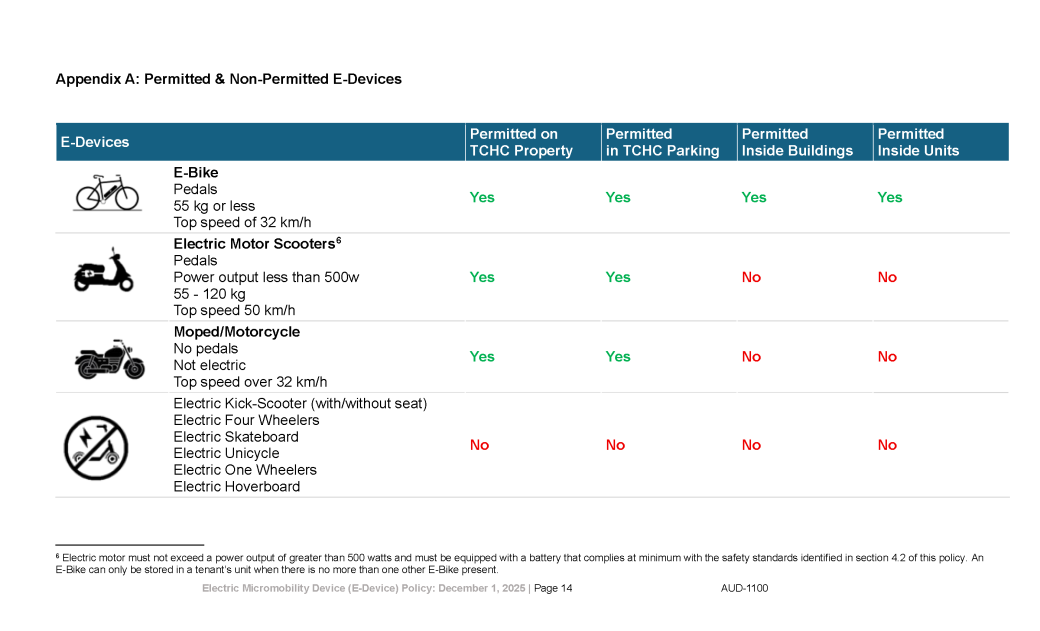
Appendix A: Permitted & Non-Permitted E-Devices
