
Deep retrofits to a TCHC building will provide savings and data for future retrofits
TCHC is participating in a University of Toronto study that will compare and contrast the effectiveness of the deep energy saving retrofits at two buildings.
Toronto Community Housing (TCHC) is participating in a University of Toronto study that will compare and contrast the effectiveness of the deep energy saving retrofits at two of its buildings. The testing will take place at 2 and 5 Brahms Avenue in North York, two identical buildings.
2 Brahms will undergo a deep retrofitting program, and its energy use will be measured against 5 Brahms. After completing the study, 5 Brahms will also be upgraded, with possible improvements from lessons learned over the coming year.
TCHC’s President and Chief Executive Officer Sean Baird recently toured 2 Brahms Avenue with Ward 17 City Councillor Shelley Carroll. They were also joined by Dr. Marianne Touchie from the University of Toronto and Kevin Stelzer, the architect who designed and oversaw the retrofits.
The building improvements made to 2 Brahms Avenue include new windows, balcony doors, unit door seals, the building’s heating, air conditioning and ventilation systems and new insulated building exterior cladding. The improvements give tenants the ability to control the temperature in their units. Beyond the energy savings, what makes this project special is that TCHC has been able to keep residents in their homes while the work is underway.
Through this project and others like it, TCHC’s Facilities Management (FM) team are leading the housing sector in conducting deep retrofits while keeping tenants in their units using innovative techniques and enhanced tenant engagement. Since 2019, FM has invested $340 million dollars on these types of projects in 39 communities, benefitting more than 6,000 homes.
“This study is an excellent example of the partnerships we are building to benefit our tenants,” said Sean. “Retrofitting an older building extends its lifespan and creates long-term savings in energy costs, but most importantly it gives tenants a safe, reliable home they can live in comfortably and confidently.”
After touring the building, Councillor Carroll was impressed with the finished product: “I’m really proud of the retrofitting of 2 Brahms. To see the realization of this retrofit, when we were talking about it in Tower Renewal back in 2007, is really a long time coming, but absolutely thrilling to see it come to fruition.”
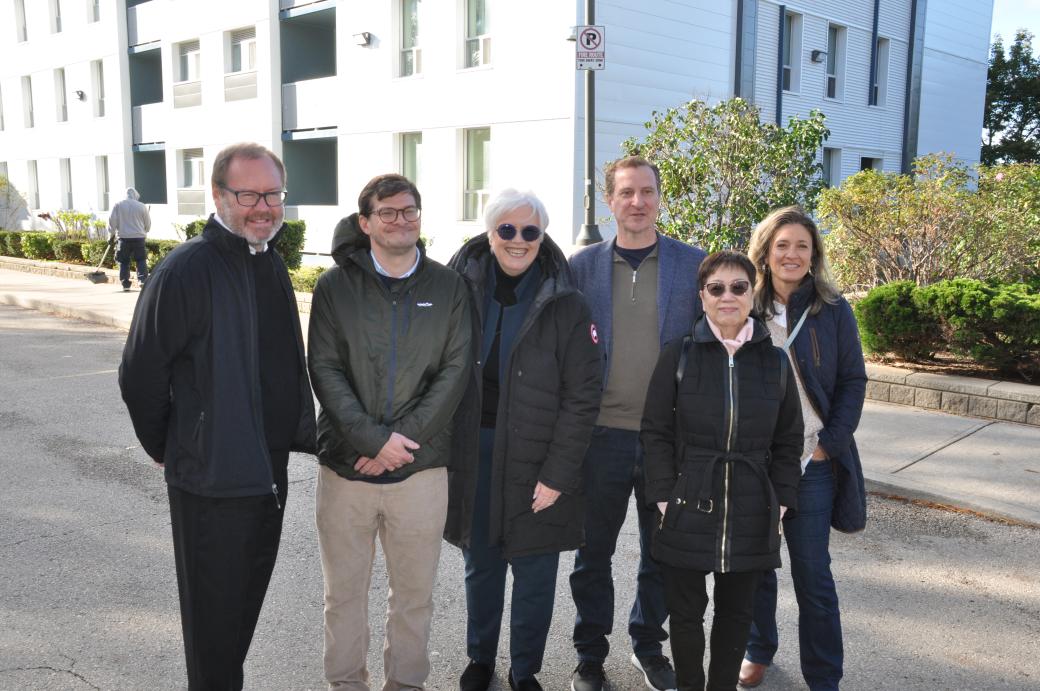
Councillor Shelley Carroll touring 2 Brahms Avenue with TCHC staff.
With an identical building across the street from 2 Brahms, it’s a perfect opportunity for the University of Toronto to compare what kind of energy savings and improvements in tenant comfort can be had when the retrofits are finished.
Dr. Marianne Touchie is an Associate Engineering Professor jointly appointed in the Departments of Civil and Mineral Engineering and Mechanical and Industrial Engineering at the University of Toronto. She is one of the lead investigators for the Hub for Advancing Buildings. She is also the Director of the Building Energy and Indoor Environment Lab who is responsible for this case study, along with Professor Liam O’Brien from Carleton University.
“I’m pretty sure this is the only such comparison happening in the world right now between centralized and decentralized ventilation systems,” said Marianne. “It’s a unique opportunity to really look at the data between two identical buildings, one completely retrofitted and one in essentially original condition.”
She said over the coming year the data will be analyzed by her team, led by PhD candidate Justin Berquist, and will form the basis for recommendations to make 2 Brahms even more efficient as well as provide lessons learned to inform the retrofit scheduled at 5 Brahms.
Kevin Stelzer, the project architect, said he expects to see energy savings of almost 50 per cent as well as a vastly reduced carbon footprint. The retrofits will validate the energy savings and the new ventilation systems and building cladding will result in a large heat recovery benefit, said Kevin.
“We’re excited to share what we learn here,” said Sean after the tour. “We’re expecting to prove significant savings and energy efficiencies because of these investments, which were funded by the City of Toronto and the Canadian Mortgage and Housing Corporation (CMHC). The results will allow us to apply the lessons learned across our whole portfolio and give other housing providers the data to make similar investments for their own tenants.”
